Tutorial Speakers
The tutorial speakers listed below will present their innovative technical contributions and applications throughout the conference, addressing some of the most challenging technologies in the field of photonics
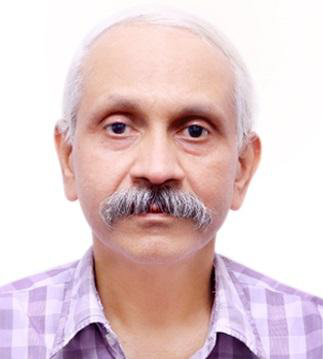
S. Sundar Kumar Iyer
Professor, Department of Electrical Engineering, IIT Kanpur
Title of the Talk: Flexible Electronics – Basics, Research Areas and Applications
Abstract
As electronics and its applications evolve, there is need to think of novel and innovative approaches to implement the technology as per emerging applications and needs of society. In many instances, flexible electronics provides opportunities which are more attractive and practical that that offered by traditional electronics. This tutorial will introduce the basics of flexible electronics and the motivations for pursuing it. A glimpse of varied research areas that are opened up in flexible electronics – from materials, to fabrication processes to devices – will be presented. The tutorial will conclude with a discussion on examples of applications – existing and potential – being pursued with the help of flexible electronics by researchers and innovators around the world.
Useful Reference Books for Students:
1. “Introduction to Flexible Electronics” Aftab M. Hussain; 2021 CRC Press
2. “Organic Flexible Electronics – Fundamentals, Devices, and Applications” Edited by Piero Cosseddu and Mario Caironi; 2021 Elsevier Ltd.
3. “Flexible and Stretchable Electronics: Materials, Designs, and Devices” Edited by Run-Wei Li and Gang Liu; 2020 Jenny Stanford Publishing Pte. Ltd.
Biography
S. Sundar Kumar Iyer is a faculty member in the Department of Electrical Engineering at the Indian Institute of Technology Kanpur. He is also a part of the Samtel Centre for Display Technologies and a founding member of the National Centre for Flexible Electronics at the institute. He is a member of Flexible Electronics and Displays Committee of IEEE Electron Device Society. His main area of research interest is organic solar cells. He and his FlexPV team are involved in building solar cells and modules on flexible substrates that can be used for practical electronic systems.
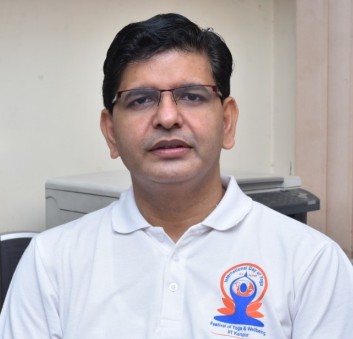
Kumar Vaibhav Srivastava
Professor, Department of Electrical Engineering, IIT Kanpur
Title of the Talk: Metamaterials and Metasurfaces for next generation Stealth System
Abstract
The advancement in detection techniques in current warfare scenarios is a key in any military operation. The survivability of any tactical assets depends upon its detectability by the state-of-the art Radar sensors. Recently, metamaterial (meta-surface) or frequency selective surfaces-based absorbers have been developed for microwaves frequencies and have been projected for stealth/camouflage applications.
The next generation of stealth technology will go beyond conventional microwave absorbers, camouflage paints, and shaping. Active and reconfigurable metasurfaces have emerged as promising candidates for enhanced stealth capabilities, since their electromagnetic response can be dynamically controlled in real time, unlike conventional metasurfaces with fixed properties post-fabrication. These advanced materials enable rapid switching between reflective and absorbing states, as well as the transformation of rasorber surfaces (absorbers with transmission band) into fully absorbing structures. Furthermore, the space-time modulated metasurfaces offer novel avenues for Doppler radar evasion by selectively generating harmonics or side bands and suppressing the main reflected wave. This tutorial explores the principles, applications, and challenges associated with next-generation stealth technologies, focusing on their implementation in dynamic battlefield scenarios.
Biography
Dr. Kumar Vaibhav Srivastava has received the B.Tech. degree in Electronics Engineering from Kamla Nehru Institute of Technology, Sultanpur, India, in 2002, the M. Tech. and Ph.D. degree in Electrical Engineering from Indian Institute of Technology Kanpur, India, in 2004 and 2008 respectively. He is recipient of Cadence Gold Medal for Best M.Tech. Thesis in any of the Engineering Departments at IIT Kanpur. After completing his PhD program, he worked with GE (General Electric) Global Research Centre Bangalore for one year in 2008 where he contributed significantly to the Wireless Power Transfer program. He joined as an Assistant Professor at Department of Electrical Engineering, Indian Institute of Technology Kanpur, India, in January 2009. He has been serving as Professor with Department of Electrical Engineering, Indian Institute of Technology Kanpur, India since 2018. He served as Head, Department of Electrical Engineering, IIT Kanpur between March 2023 and July 2024. He has been serving as Dean of Administration, IIT Kanpur since July 2024. He has authored more than 350 journal and conference papers with international repute. He has supervised 55 M.Tech. thesis and 15 Ph.D. thesis till date and is currently involved with supervision of 2 M.Tech. and 9 Ph.D. students. He has two international and six national patents to his credits. His group is well known in the world for microwave metamaterial surfaces, and his works have received more than eight thousand five hundred citations. He is also involved with several research projects with Department of Science and Technology (DST), Indian Space Research Organization (ISRO), Defense Research and Development Organization (DRDO), Ministry of Eduction (MoE), General Electric (GE) etc.
He is recipient Young Fellowship Awards (Class of 1979 Research Fellowship in 2013 and Dr. Shukla Faculty Research Fellowship in 2017) from IIT Kanpur for his significant contribution as a faculty member at IIT Kanpur. He also served as a Sanjay & Rachna Pradhan Chair Professor at IIT Kanpur between May 2022 and April 2025 for his excellent academic credentials. He has received the Excellence in Teaching Award-2020 at IIT Kanpur for his outstanding teaching. He is also recipient of ‘IEI (Institution of Engineer, INDIA) Young Engineer Award for year 2014-15 for his significant contribution in Electrical Engineering. He has received Motohisa Kanda Award 2022 for the highest citations among all the papers published in the last 5 years (2017-2021) in IEEE Transactions on Electromagnetic Compatibility. He has received several Best Paper Awards in international conferences. He is currently Yadupati Singhania Memorial Chair Professor at IIT Kanpur. His research interests include meta-materials, microwave antennas, MIMO antennas, microwave absorbers, finite-difference time-domain (FDTD) technique and microwave cloaking. He is member various professional societies like IEI, IET, Senior Member of IEEE and Fellow of IETE,. He has served as Chairman of IEEE UP Section and Executive Committee Member of IEEE India Council. He is also founding chair of IEEE AP Society Chapter and IEEE Aerospace Electronics System Society Chapter in Uttar Pradesh Section.
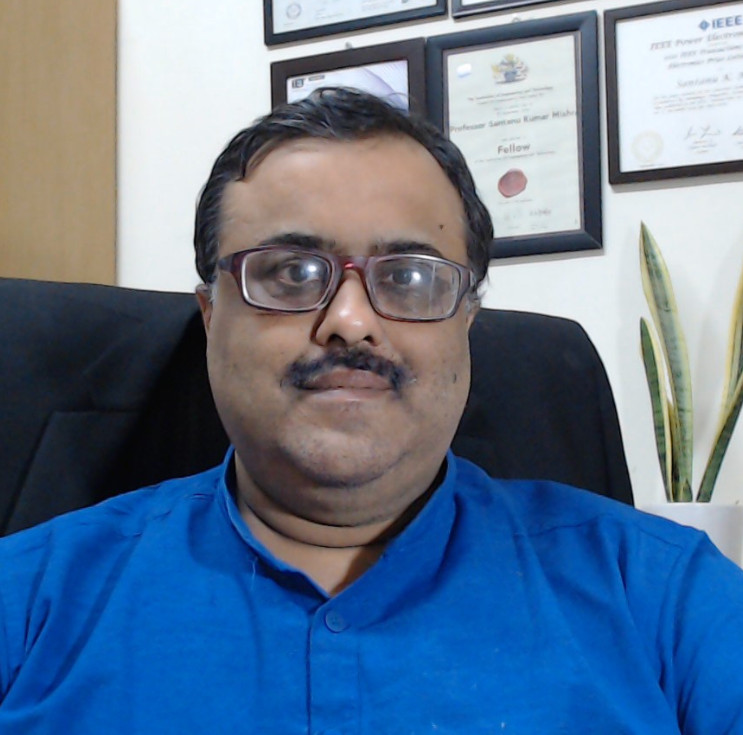
Santanu K. Mishra
Professor and Head, Center for Automotive Research and Tribology (CART) IIT Delhi,
Title of the Talk: Commercializing Power Components in Indian Universities: Walking
the talk
Abstract
The talk will concentrate on challenges faced in commercializing power components in India. Some experiences of the Presenter on commercializing current sensors, power converter topology, protection devices, embedded controller will be discussed during this presentation. The talk will discuss the expectations of Indian industry when they work with Universities. It will also provide some challenges that are placed by administration and how they can be smoothened foraccelerated output.
Biography
Prior to joining CART, he worked with Infineon Technologies, Rhode Island, USA from 2004 to 2008. He was a faculty at IIT Kanpur from 2008 to 2023. Currently, he is a Professor with CART, IIT Delhi.
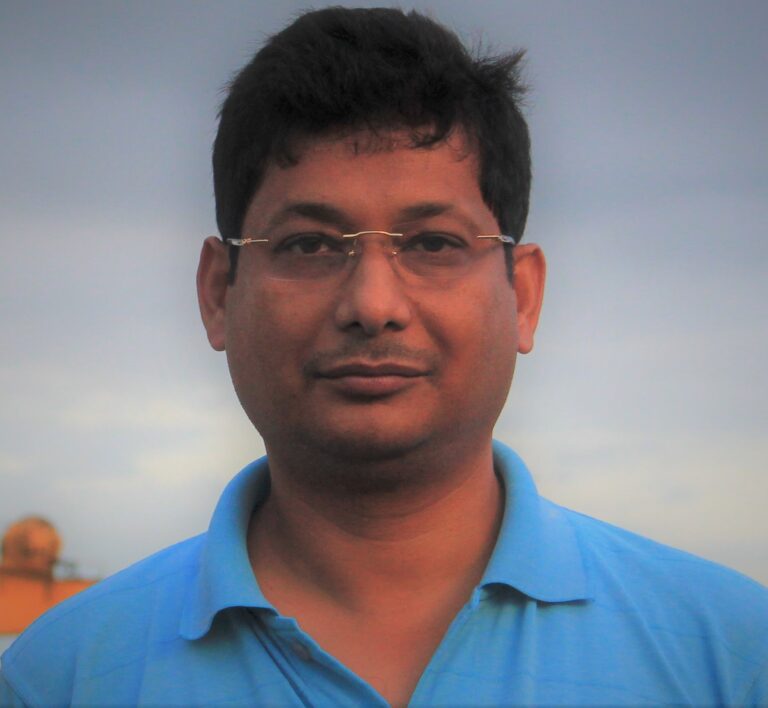
M. K. Bhuyan
Professor, Department of Electronics & Electrical Engineering, IIT Guwahati
Title of the Talk: Transformers Beyond Language: The Rise of Vision Transformers
Abstract
This talk introduces the fundamental concepts of transformer architecture, including self-attention and encoder–decoder models, which revolutionized natural language processing (NLP). It then explores the evolution of transformers in computer vision through Vision Transformers (ViTs), where images are processed as sequences of patches for effective global feature learning. The talk further discusses Swin Transformers, which improve efficiency and scalability using hierarchical representations and shifted-window attention mechanisms. Applications in image classification, object detection, medical imaging, video analysis, and intelligent systems will also be presented, along with recent advances and future directions in transformer-based vision technologies.